
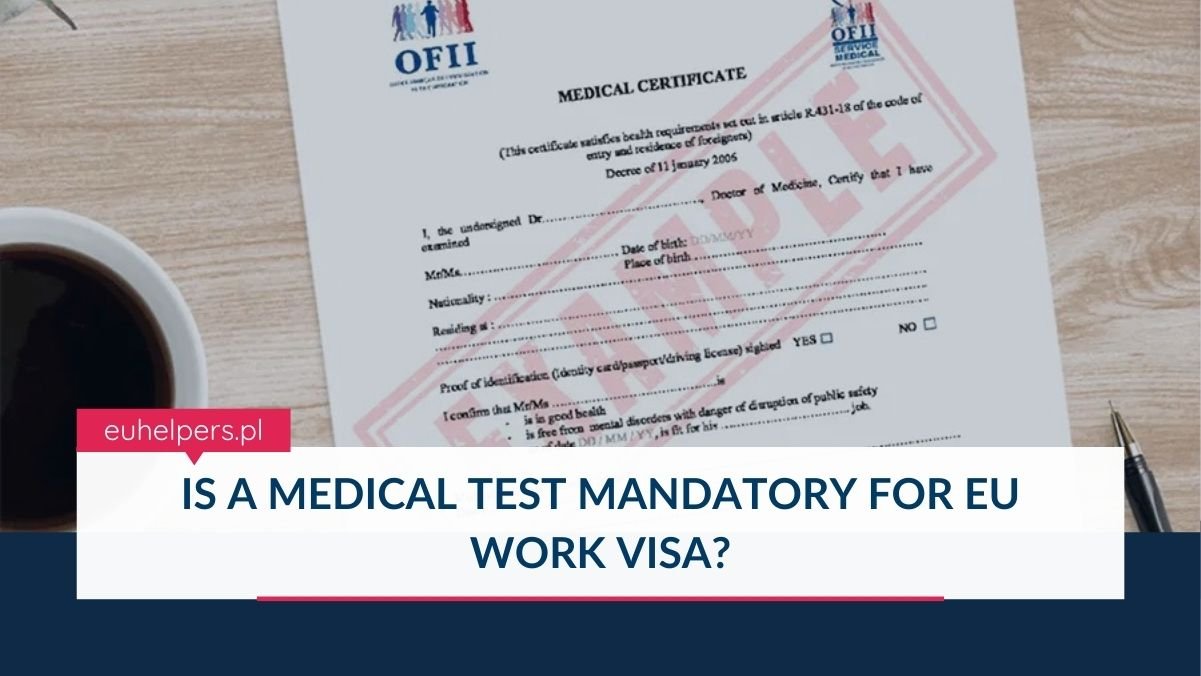
Yes, a medical test is mandatory for most EU work visas, but the type of test and timing depend on the country and job role.
When Is a Medical Test Required for EU Work Visas?
Most EU countries require proof that the worker:
-
Is medically fit to work
-
Does not pose a public health risk
-
Can safely perform the job duties
This rule applies across the European Union, but implementation is handled by individual countries.
Types of Medical Tests for EU Work Visas
Medical Fitness Certificate
-
Issued by a registered doctor or approved medical center
-
Confirms general fitness for employment
-
Often mandatory for blue-collar and physical jobs
Tuberculosis (TB) Test
-
Required by many EU countries for applicants from certain regions
-
Chest X-ray or lab test may be needed
-
Results must be recent (usually within 3 months)
Occupation-Specific Medical Tests
Some jobs require extra checks:
-
Healthcare workers: infectious disease screening
-
Food handlers: hygiene and communicable disease checks
-
Construction & factory jobs: physical fitness assessment
Country-Specific Medical Test Rules
Medical requirements vary by country, even within the EU.
-
Germany: Often requires a medical fitness certificate; TB test for some applicants
-
France: Medical checks may be done after arrival through OFII
-
Italy & Spain: Basic medical certificate is commonly required
-
Poland, Romania, Hungary: Medical fitness certificate usually mandatory before visa approval
Always follow embassy or employer instructions.
Is a Medical Test Required for an EU Blue Card?
For the EU Blue Card:
-
Many countries do not require a pre-visa medical test
-
Health insurance proof is usually sufficient
-
Medical examination may happen after arrival during residence registration
However, exceptions apply for healthcare and high-risk professions.
Who May Be Exempt from Medical Tests?
You may not need a medical test if:
-
You are applying for a short-term or intra-company transfer
-
Your role is office-based and low risk
-
The host country conducts health checks after arrival
Final decision always rests with the embassy or immigration authority.
Who Conducts the Medical Test?
-
Government-approved hospitals or clinics
-
Panel doctors listed by the embassy (in some countries)
-
Registered medical practitioners (with stamp & signature)
Unapproved medical reports may be rejected.
Validity of Medical Reports
-
Usually valid for 3 to 6 months
-
Must be recent at the time of visa submission
-
Some countries require original stamped reports
Common Mistakes to Avoid
-
Using non-approved clinics
-
Submitting expired medical reports
-
Missing TB test when required
-
Assuming medical tests are optional
How EU Helpers Can Assist
EU Helpers supports applicants by:
-
Confirming country-specific medical requirements
-
Guiding approved medical centers
-
Checking medical report formats
-
Coordinating employer and embassy instructions
Final Answer
Yes, a medical test is mandatory for most EU work visas, especially for long-term, blue-collar, healthcare, and public-facing jobs. The exact test depends on the country, profession, and visa type.