
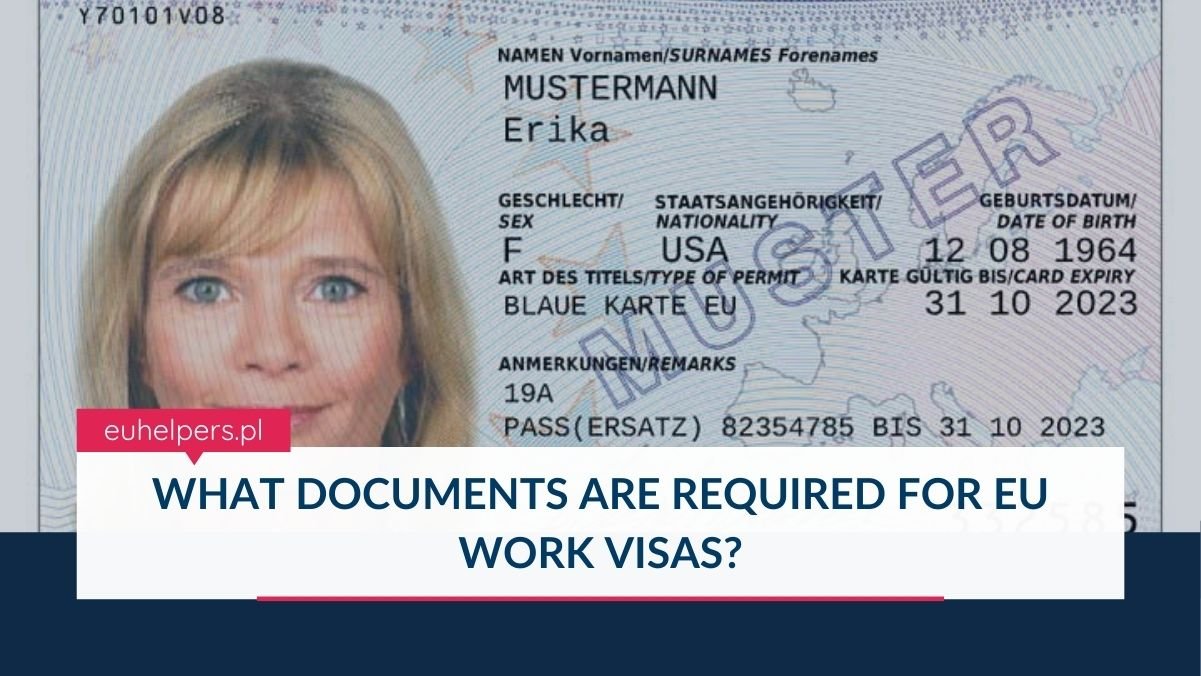
If you are planning to work in Europe, one of the most important steps is preparing the correct documents for your EU work visa. Missing or incorrect paperwork is one of the main reasons visa applications get delayed or rejected.
Understanding EU Work Visas (Quick Overview)
An EU work visa allows non-EU nationals to live and work legally in a country within the European Union.
Each country has its own rules, but most document requirements are similar across Europe.
Some popular work visa types include:
-
National Work Visa (Type D)
-
EU Blue Card (for skilled professionals)
-
Seasonal / Temporary Work Visa
-
Intra-Company Transfer Visa
Core Documents Required for All EU Work Visas
These documents are mandatory in almost every EU country.
Valid Passport
-
Must be valid for at least 6–12 months
-
Should have 2–3 blank pages
-
Issued within the last 10 years
EU Work Visa Application Form
-
Fully completed and signed
-
Country-specific format
-
Online or paper-based, depending on the embassy
Passport-Size Photographs
-
Recent photos (usually within 6 months)
-
White background
-
Biometric standards as per Schengen rules
Employment-Related Documents
These prove that you have a real job offer in Europe.
Job Offer or Employment Contract
-
Signed by employer and applicant
-
Must mention:
-
Job title
-
Salary
-
Working hours
-
Contract duration
-
Work Permit Approval (If Applicable)
-
Issued by the labor authority of the EU country
-
Often applied for by the employer
-
Required before visa submission in many countries
Qualification & Experience Documents
Requirements depend on whether the job is skilled or blue-collar.
Educational Certificates
-
Degree, diploma, or trade certificate
-
Translated into English or local language
-
Sometimes needs apostille or legalization
Work Experience Proof
-
Experience letters from previous employers
-
Payslips or contracts (if requested)
-
Especially important for skilled jobs
Language Requirement Documents
Some EU countries require language proof.
Language Certificate (If Required)
-
Common languages: German, French, Italian, Dutch
-
Levels usually range from A2 to B2
-
Accepted institutes may include Goethe, TELC, IELTS, etc.
Note: Not all jobs require language certificates, especially entry-level or seasonal roles.
Financial & Accommodation Proof
These documents show you can support yourself initially.
Proof of Financial Means
-
Bank statements (last 3–6 months)
-
Minimum balance varies by country
-
Salary slips (if already working)
Accommodation Proof
-
Rental agreement
-
Employer-provided housing letter
-
Hotel booking (temporary stays)
Health & Insurance Documents
Healthcare coverage is mandatory across the EU.
Health Insurance
-
Valid in the destination country
-
Minimum coverage as per embassy rules
-
Must cover medical emergencies
Medical Fitness Certificate
-
Issued by an approved doctor
-
Confirms you are fit to work
-
Some countries require TB test results
Police & Background Documents
These ensure safety and legal compliance.
Police Clearance Certificate (PCC)
-
Issued by home country authorities
-
Shows no criminal record
-
Validity usually 3–6 months
Additional Country-Specific Documents
Some EU countries may request extra paperwork.
Visa Fee Payment Receipt
-
Fees vary by country and visa type
-
Usually non-refundable
Cover Letter
-
Explains:
-
Why you want to work in that country
-
Job role and employer details
-
Future plans
-
CV / Resume
-
Europass format preferred
-
Updated and job-specific
Documents Required for EU Blue Card Applicants
The EU Blue Card is for highly skilled professionals.
Additional documents include:
-
Recognised university degree
-
Salary meeting minimum Blue Card threshold
-
Degree equivalency or recognition proof
Translation & Legalisation Requirements
Most embassies require:
-
Certified translations (English or local language)
-
Apostille or embassy legalisation (in some cases)
Always check country-specific embassy guidelines.
Common Mistakes to Avoid
-
Submitting expired documents
-
Missing signatures
-
Incorrect photo size
-
Fake or unverifiable job offers
-
Incomplete translations
Final Checklist Before Submission
Before applying, make sure:
-
All documents are complete and updated
-
Copies and originals are arranged
-
Employer documents are verified
-
Embassy appointment is confirmed
How EU Helpers Can Support You
At EU Helpers, we assist with:
-
Document checklist based on country & job
-
Employer verification
-
Work permit guidance
-
Visa file preparation
-
Post-arrival support in Europe